
The gauges at the gas station measure the overpressure in the tire, i.e., how much higher the pressure in the tire is than the current ambient air pressure. (See also: Wikipedia - Tire pressure)
However, ambient air pressure depends on the location of a place (altitude above sea level) and the atmospheric temperature, and on average decreases by about 100 hPa (equivalent to 0.1 bar) for every 1000 meters of altitude.
(The exact formula is more or less complex depending on the approximation method. Details can be found at...) Wikipedia air pressure.)
Another important factor influencing tire pressure is, of course, the temperature inside the tire, or, to a first approximation, the tire temperature.
This relationship is expressed by the so-called Gas lawIf the (absolute) temperature increases by 10%, then the (absolute) pressure also increases by 10% if the volume does not change – this can be assumed for a closed tire.
As a guideline, with a cold inflation pressure of 2 bar, it can be assumed that a temperature increase of 30 degrees (approx. 10%) increases the tire pressure by 0.3 bar.
If you want to measure your tire pressure "accurately", you must:
Measure at the same altitude, the same outside temperature and the same tire temperature; to avoid differences between measuring devices, always use the same device.
The displayed value is then to be considered "accurate" for this location, at this time of day and for this tire condition.
What does a TireMoni sensor measure?
TireMoni sensors measure the overpressure relative to a reference chamber within the sensor and are therefore independent of ambient air pressure. The sensor readings are calibrated at sea level.
This offers the user three crucial advantages compared to measuring at the gas station:
- The measurement is taken regularly; a glance at the display is sufficient.
- The measurement is reliable because it is always done with the same device.
- Deviations from the target state are detected and reported so early that sufficient time (>15 min) remains for a safe response.
Above all, the last point makes TireMoni invaluable for the driver, as the much longer reaction time in the event of a breakdown offers choices (changing the tire or driving to the workshop) and thus always ensures that a safe place to stop can be found.
And what about measurement accuracy?
The actual measurement accuracy of the TireMoni is therefore not yet relevant to the decisive advantages. It only becomes important when you want to fully exploit the other advantages of tire pressure monitoring:
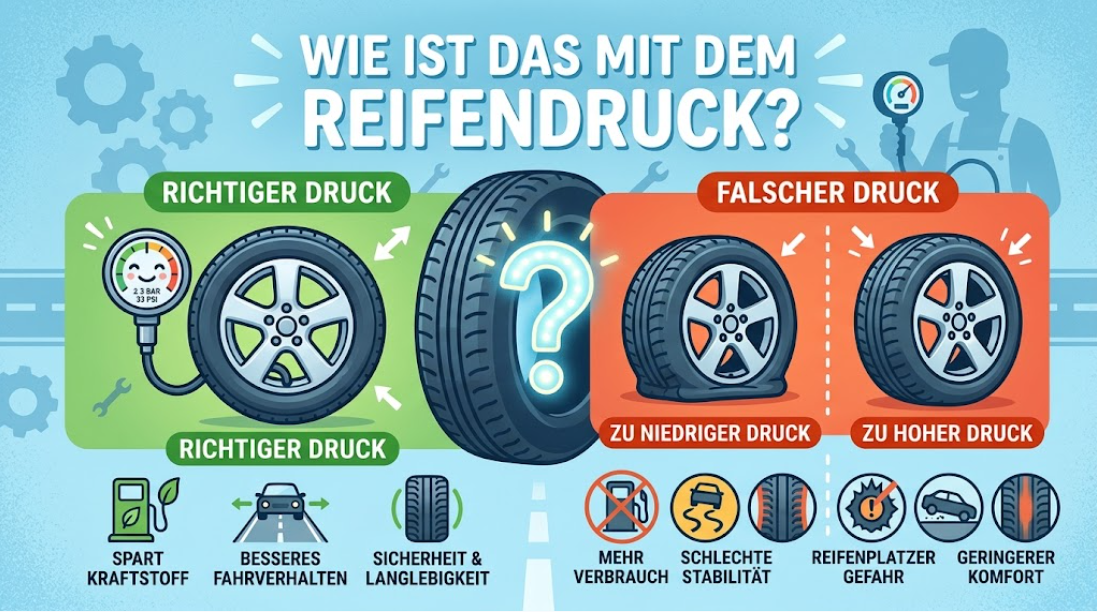
- Reduced fuel consumption and
- higher tire mileage
However, it's important to note that the optimal tire pressure in relation to these aspects is a compromise that needs to be determined through experience. Too many parameters influence the result (driving style, typical route selection, load, tire choice, etc.).
The values in the vehicle manual can be considered a "usable" starting point. Tire manufacturers tend to recommend values that are 0.2 to 0.3 bar higher.
It is important to compare like with like; for this, you must always measure with the same measuring device, so it is best to always have the measuring device with you, as with TireMoni.
It's equally important to measure frequently so you develop a feel for how the tire pressure affects fuel consumption and tire mileage. With TireMoni, a single glance at the display is all it takes.
Due to its measuring principle, TireMoni shows the same readings at sea level as a calibrated pressure gauge; at 400 m altitude, the device shows 0.04 bar "too low" – this is negligible in practice.
At an altitude of 2500 m above sea level, the deviation is 0.25 bar, meaning TireMoni displays 2.0 bar where the actual pressure is 2.25 bar. Setting the pressure to the value recommended by the car manufacturer ensures that the tire manufacturer's recommended values are indeed correct. The displayed values are then closer to the set warning thresholds, so safety is not compromised.
The advantage of the TireMoni principle is that TireMoni always displays the same reading, whether driving from a deep valley to high mountains or back down again. This means you know immediately: if the pressure reading on the TireMoni drops, then the tire is losing pressure.
If, on the other hand, one had a measuring device that measures against the ambient pressure, one would first have to calculate, when driving down into the valley, whether the reduced pressure value corresponds to the difference in altitude, or whether there is actually a pressure loss.
And for those who really need absolute precision, TireMoni is of course also available. The process works like this:
- Determine the current air pressure using a calibrated barometer.
- Using the sources/formulas mentioned above, the current air pressure and the target tire pressure, determine the absolute pressure to be set in the tire.
- Subtract 1 bar from the absolute pressure – this is the tire pressure that TireMoni should display after inflation.
- Measure the tire temperature – it should be between 17 and 20 degrees Celsius; if necessary, cool or heat until this temperature is reached.
- Adjust the tire pressure to the determined inflation pressure.
Don't forget: if the air pressure changes or you are traveling at a different altitude above sea level, the tire pressure must of course be adjusted; the same applies if you change the vehicle's load condition.